
Complete Guide to Hong Kong Companies Ordinance: Accounts and Audit (FAQ)
Complete Guide to Hong Kong Companies Ordinance: Accounts and Audit (FAQ)
Quick Summary (Direct Answer):
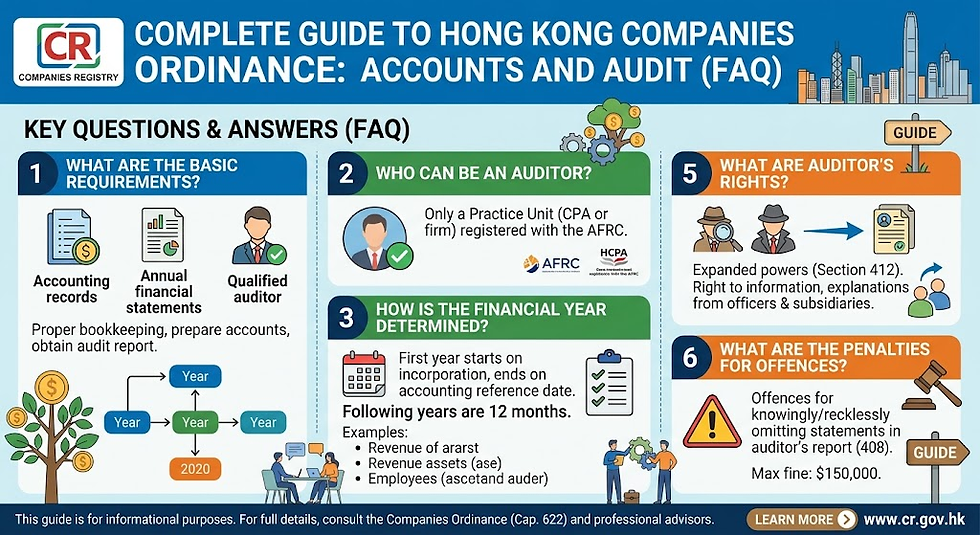
Under Hong Kong’s Companies Ordinance (Cap. 622), local companies must maintain proper accounting records, prepare annual financial statements, and have their accounts audited by a qualified practice unit (certified public accountant or CPA firm). However, qualifying small-to-medium-sized enterprises (SMEs) and groups may be eligible for reporting exemptions to simplify compliance.
Table of Contents
1. Overview of Accounts and Audit Requirements
Maintaining proper financial records is a statutory obligation for every company registered in Hong Kong. Under the Companies Ordinance (Cap. 622):
Accounting Records: Companies must keep accounting records that correctly record and explain their transactions and financial position, enabling financial statements to be prepared.
Financial Statements: Directors must prepare annual financial statements (including a profit and loss account and balance sheet) for every financial year.
Statutory Audit: These financial statements must generally be audited by an eligible auditor (a practice unit under the Accounting and Financial Reporting Council Ordinance).
2. Key Definitions & Financial Year Calculations
What is a "Financial Year"?
A company’s financial year determines the period covered by its annual financial statements.
First Financial Year: Begins on the first day of its first accounting reference period and ends on the last day of that period (or within 7 days before or after, as specified by the directors). For a newly incorporated company, it starts on the incorporation date and ends on its primary accounting reference date.
Subsequent Financial Years: Begin on the day immediately following the end of the previous financial year and end on the last day of the following accounting reference period.
What is an "Accounting Reference Period"?
An accounting reference period is the 12-month span (unless shortened or extended) used to prepare annual financial statements.
3. Reporting Exemptions for Small & Medium Enterprises (SMEs)
To reduce compliance costs, the Companies Ordinance offers reporting exemptions for qualifying private companies and groups:
Small Private Companies: A private company that meets specific size tests (concerning total revenue, total assets, and number of employees) for a financial year can qualify as a small private company.
Eligible Private Companies: Private companies can opt out of certain reporting requirements if 75% of members pass a resolution approving the exemption (with no members objecting).
Small Guarantee Companies: Non-profit or guarantee companies meeting relevant scale thresholds are similarly exempted.
4. Auditor Rights, Responsibilities, and Offences
Enhanced Rights (Section 412): Auditors have expanded powers to require information and explanations from the company, its officers, employees, and subsidiaries to properly perform their statutory duties.
Auditor’s Report Offences (Section 408): To safeguard financial integrity, it is an offence if an auditor knowingly or recklessly omits required statements (e.g., failure to state whether financial statements agree with accounting records) from an auditor's report, carrying fines up to $150,000.
5. Frequently Asked Questions (FAQ)
Q1: Who is eligible to be appointed as a company auditor in Hong Kong?
A: Only a practice unit is eligible for appointment. This includes:
A certified public accountant (practising) practicing on their own account.
A CPA firm defined under the Accounting and Financial Reporting Council Ordinance (AFRCO).
A corporate practice defined under the AFRCO.
Q2: How is the first financial year determined for a newly incorporated company?
A: Under Section 367 and 368 of the Companies Ordinance, the first accounting reference period for a company formed and registered under the new CO begins on its date of incorporation and ends on its primary accounting reference date.
Q3: Can a small private company in Hong Kong be exempted from a statutory audit?
A: While reporting exemptions can reduce the volume of disclosures in directors' reports or financial statements (e.g., allowing simplified statements), the overarching audit requirement depends on company classification, shareholder resolutions, and specific statutory criteria under Part 9 of the Companies Ordinance. Companies should review specific size thresholds or seek professional accounting advice.
Q4: What happens if an auditor omits mandatory details from an auditor's report?
A: Under Section 408 of the Companies Ordinance, any eligible auditor or associated partner/employee who knowingly or recklessly causes required statements to be omitted from an audit report commits an offence and is liable to a fine not exceeding $150,000.
For the definitive legal provisions, exact statutory text, and official forms, please refer directly to the Hong Kong Companies Registry and the Hong Kong e-Legislation.
Complete Guide to Hong Kong Companies Ordinance: Accounts and Audit (FAQ)


Comments