
Understanding Variable Interest Entities (VIEs)
Understanding Variable Interest Entities (VIEs)
What is a Variable Interest Entity (VIE)?
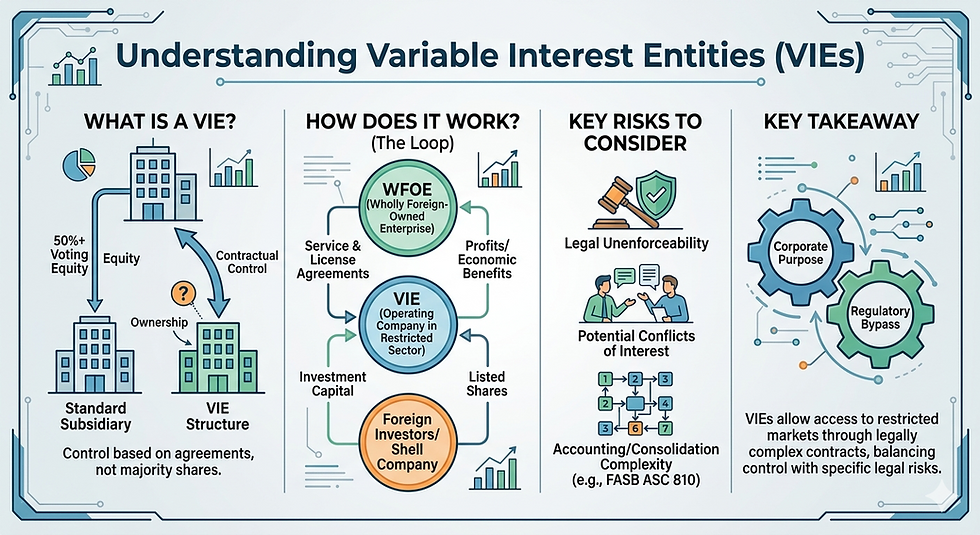
A Variable Interest Entity (VIE) is a legal business structure where a controlling interest is not based on having the majority of voting rights. Instead, control is established through contractual arrangements.
In a standard corporation, you control the company by owning more than 50% of the voting shares. In a VIE, the "primary beneficiary" (the company that consolidates the VIE on its balance sheet) may own little to no equity but still directs the entity's activities and absorbs its significant losses or residual returns.
Why Use a VIE?
The VIE structure is most famously used by Chinese companies (like Alibaba, Tencent, and Baidu) to bypass domestic restrictions on Foreign Direct Investment (FDI) in sensitive sectors like telecommunications, technology, and media.
Regulatory Navigation: Foreign investors cannot legally own shares in certain Chinese industries.
Access to Global Capital: The VIE structure allows these companies to list on foreign stock exchanges (like the NYSE or NASDAQ).
Risk Isolation: It can be used to isolate assets or specific projects from the parent company’s primary balance sheet, though accounting rules have tightened significantly to prevent "off-balance sheet" abuses.
How the VIE Structure Works
The setup typically involves three main layers:
The Investor: Usually a shell company incorporated in an offshore tax haven (e.g., the Cayman Islands) that lists on a global stock exchange.
The WFOE (Wholly Foreign-Owned Enterprise): A subsidiary established by the offshore company within the host country (e.g., China).
The VIE (Operating Company): The domestic entity that holds the actual business licenses and operates the business.
The WFOE and the VIE sign a series of legal contracts (powers of attorney, equity pledge agreements, and exclusive service agreements). These contracts ensure that the profits of the VIE are funneled to the WFOE and, ultimately, to the foreign investors.
Key Risks
While widely used, the VIE structure carries unique risks that investors and auditors must monitor:
Legal Enforceability: Because the structure is designed to circumvent ownership laws, the host government could technically declare the contracts illegal or unenforceable at any time.
Conflict of Interest: The nominal owners of the VIE (often the company's founders) could decide to break the contracts, leading to costly legal battles in local courts.
Consolidation Complexity: Under accounting standards like FASB ASC 810, a company must determine if it is the "primary beneficiary." This requires a complex analysis of who has the power to direct the activities that most significantly impact the entity’s economic performance.
Summary Comparison
Feature | Standard Subsidiary | Variable Interest Entity (VIE) |
|---|---|---|
Control Basis | Voting equity (shares) | Contractual agreements |
Ownership | Direct parent-subsidiary link | Often no direct equity link |
Purpose | Operational expansion | Regulatory bypass or risk isolation |
Primary Risk | Market/Operational risk | Regulatory/Legal validity risk |
Navigating the VIE Landscape: How Bestar Empowers Global Investors
Understanding Variable Interest Entities (VIEs)
In the complex regulatory environment of 2026, foreign investors eyeing China’s high-growth sectors—from AI and biotech to value-added telecommunications—face a unique challenge: the Variable Interest Entity (VIE) structure. As China refines its foreign investment laws, the need for a compliant, "Agentic-First" advisory partner has never been more critical.
Bestar provides the structural expertise and digital-first precision required to bridge the gap between global capital and Chinese opportunity.
1. VIE Structural Design & Compliance
The VIE structure is the lifeblood of foreign investment in China's restricted industries. However, its validity rests entirely on the strength of its contractual arrangements.
How Bestar Helps:
WFOE Setup: We facilitate the seamless incorporation of Wholly Foreign-Owned Enterprises (WFOEs) to serve as the bridge between your offshore entity and domestic operations.
Contractual Rigor: Our specialists draft and review the core "VIE Agreements"—including Exclusive Technical Service Agreements, Equity Pledge Agreements, and Powers of Attorney—to ensure they meet current Chinese regulatory scrutiny.
Regulatory Monitoring: With 2026’s evolving legal landscape, we provide real-time updates on MOFCOM and CSRC policy shifts that impact your consolidation rights.
2. Agentic-First Accounting & Audit
Efficiency is the hallmark of the Bestar brand. By pivoting to Agentic-First workflows, we replace traditional, slow-moving manual audits with AI-driven orchestration.
Real-Time Consolidation: We help foreign investors consolidate their VIE financials on their global balance sheets (ASC 810 / IFRS 10) with near-instant speed.
Tax Optimization: From VAT management to navigating China’s corporate income tax incentives for "High and New Technology Enterprises" (HNTE), our advisors ensure your tax footprint is lean and compliant.
Financial Forensic Services: As an ISCA-certified Chartered Accountants Financial Forensic Professional (FFP) led firm, Bestar provides deep-dive due diligence to protect you from internal management conflicts within the VIE.
3. M&A and Strategic Divestiture
Whether you are entering the market through an acquisition or seeking to exit a position, Bestar China serves as your lead facilitator.
Buy-Side Mandates: We identify viable domestic targets and manage the entire transaction lifecycle, from valuation (CVA-certified) to post-merger integration.
Normalized Earnings Analysis: We specialize in normalizing financial statements for Chinese SMEs, ensuring that "off-the-book" expenses or unique local subsidies are accurately reflected for global buyers.
Why Bestar China? (The 2026 Advantage)
Feature | The Bestar Difference |
|---|---|
Speed | AI-driven "Agentic-First" auditing for faster turnaround times. |
Expertise | 30+ years of cross-border accounting and corporate secretarial experience. |
Communication | Technical clarity via email; no "lost in translation" phone calls. |
Reach | Integrated services across Singapore, Hong Kong, and Mainland China. |
Expert Insight: Why Your VIE Needs an AI-First Auditor
"In 2026, the complexity of VIE structures exceeds what traditional human-only teams can manage in real-time. By orchestrating AI agents, we provide a level of oversight and data integrity that ensures your Chinese interests are both protected and profitable." — CEO of Bestar
Frequently Asked Questions
Can foreigners own tech companies in China?
Direct equity ownership is restricted in many sectors. However, the VIE structure allows foreign investors to exercise control and receive economic benefits through contractual arrangements, a process Bestar China specializes in managing.
How does Bestar ensure VIE compliance?
We ensure compliance by aligning your WFOE-VIE contracts with the latest mandates from the China Securities Regulatory Commission (CSRC) and implementing rigorous internal controls via our digital auditing platform.
Does Bestar handle corporate secretarial work?
Yes. We provide full-spectrum corporate secretarial services to ensure your Chinese entities maintain their business licenses and fulfill all annual filing requirements.
Ready to Secure Your China Growth Strategy?
Don’t leave your VIE structure to chance. Contact Bestar today for a technical consultation on cross-border compliance and AI-driven professional services.
Email: admin at bestar-asia.com
WeChat: bestar-cn
Website: www.bestar-hk.com / www.bestar-cn.com


Comments